
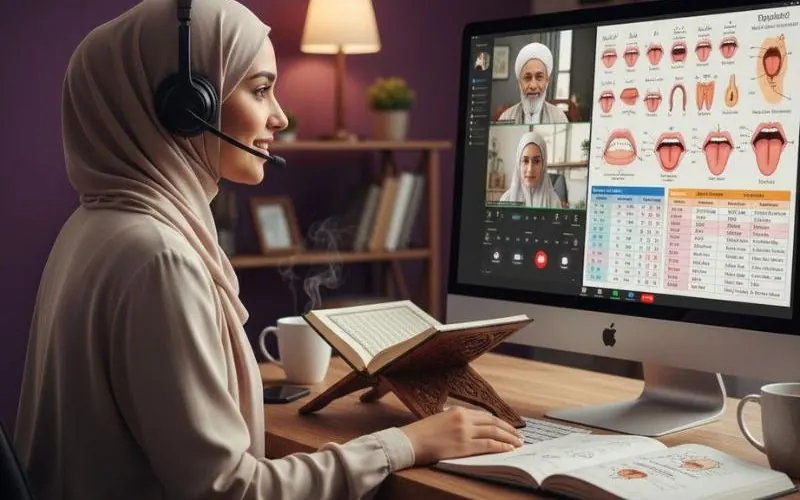
Why Tajweed matters, even for children
Tajweed is simply the set of rules for pronouncing the Quran properly: where each letter comes from, how long a sound is held, when a letter is hidden or merged. Get a letter wrong and the meaning of a word can change. That is why scholars have always taught it alongside reading, not as an extra.
Children are actually the best Tajweed students. Their mouths and ears are still flexible, and habits they form now tend to last for life. A child who learns that ض and د are different sounds at age eight won't need to unlearn a mistake at thirty.
What your child learns in our online Tajweed classes
We follow a clear order so nothing feels overwhelming. Each step is practised on real verses before moving on.
- Makharij: the exact place in the mouth and throat each letter is pronounced from.
- Sifaat: the qualities of letters, such as heavy and light letters.
- Noon sakinah and tanween: izhar, idgham, iqlab and ikhfa.
- Meem sakinah and the rules of ghunnah.
- Qalqalah: the "echo" on certain letters.
- Madd: how long to stretch each type of long vowel.
- Waqf: where to stop and start so the meaning stays clear.
We don't drown kids in Arabic terminology. Younger students learn the sound first and the name of the rule later. Older students learn both, so they can check their own recitation.
How a typical Tajweed lesson goes
Every class is live and one-on-one on Zoom or Skype. A lesson usually looks like this:
- A short warm-up, reciting what was learned last time.
- One new rule, explained with examples on a shared, colour-coded Mushaf.
- Your child reads verses using that rule while the tutor corrects in real time.
- A small piece of practice for the days in between.
Because it's one-on-one, the tutor hears every mistake. In a group class, a quiet child can hide for weeks. Here, they can't, and that's a good thing.
Who is this Tajweed course for?
It suits children who can already read the Quran from the Mushaf, even slowly. If your child is still learning letters, start with our Noorani Qaida online classes first, and Tajweed will feel much easier afterwards. Children doing Hifz also benefit a lot, because memorising with correct Tajweed from day one saves a lot of correction later. See our online Hifz classes.
Tajweed isn't only for children. Many adults who read fluently join us to fix habits they picked up years ago, in private lessons where nobody else is listening. See our Quran classes for adults.
Learning Tajweed online vs at a local masjid
Many parents ask whether you can really learn Quran with Tajweed online. You can, and for most families it works better. The tutor sees and hears your child up close, there's no travel, and you can sit in on any class. You'll also get regular progress updates, so you know which rules your child has mastered and what's next.